From a research question to a screened, ranked reading list.
Describe what you want to find out. AI Search helps you sharpen the question, runs several searches, and checks every candidate paper against explicit criteria — so you can see why each paper made the list.
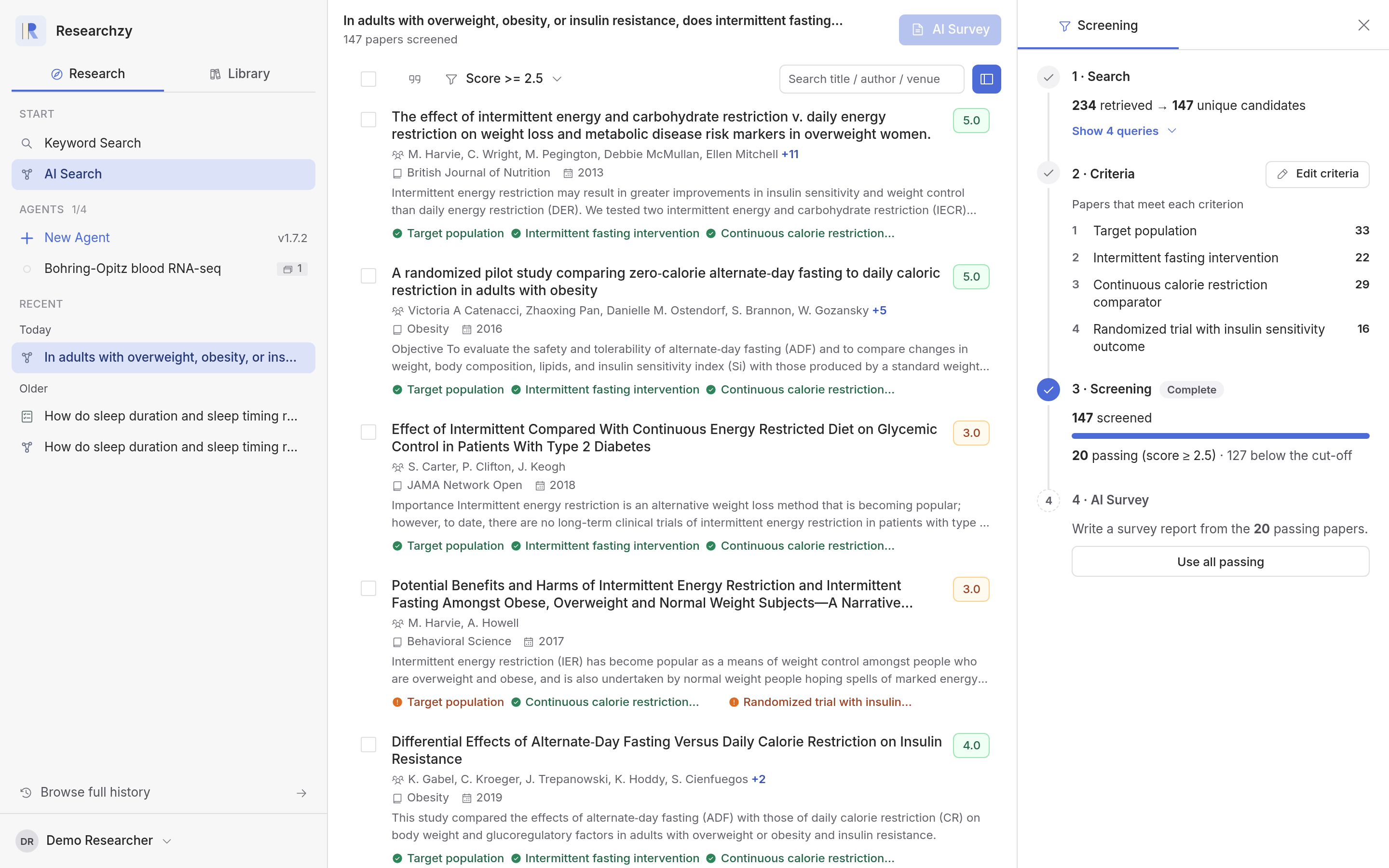
1A score for every paperEach candidate gets a 0–5 relevance score, so the best matches rise to the top.
2The criteria each paper meetsSee which of your requirements a paper meets, not just a number.
3Rules and searches in viewThe screening criteria and the searches behind the results are right beside them.
01
Sharpen the question before you search
Broad questions return broad results. With Guided search on, Researchzy asks follow-up questions first and proposes focused versions of your question that you can revise or launch.
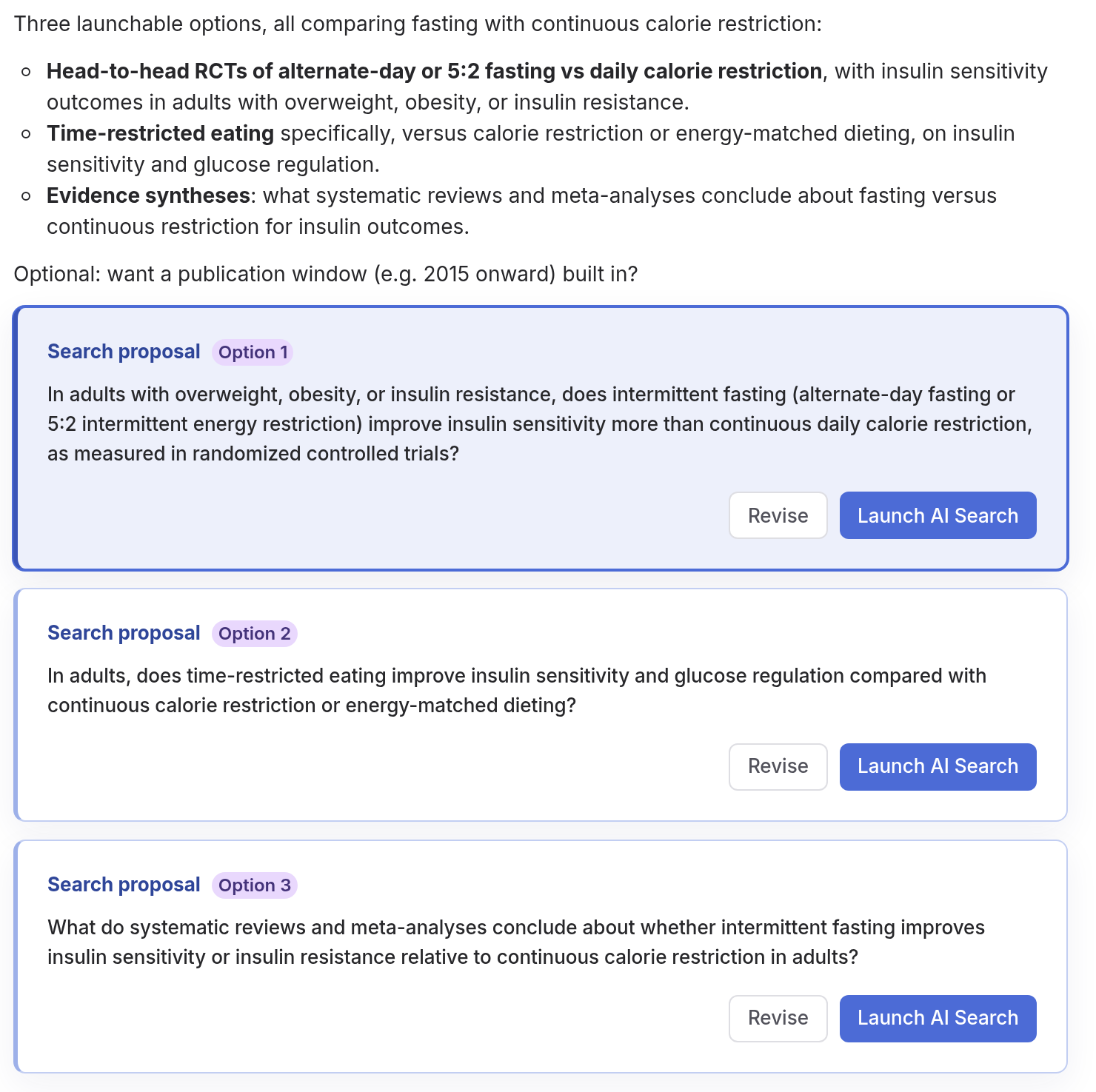
In our example, “Does intermittent fasting improve insulin sensitivity compared with continuous calorie restriction?” became three proposals: randomized trials of alternate-day or 5:2 fasting against daily calorie restriction in adults with overweight, obesity, or insulin resistance; time-restricted eating; and what systematic reviews and meta-analyses conclude.
Guided search offered three ways to frame a question about intermittent fasting and insulin sensitivity.
02
Search wider than one phrasing
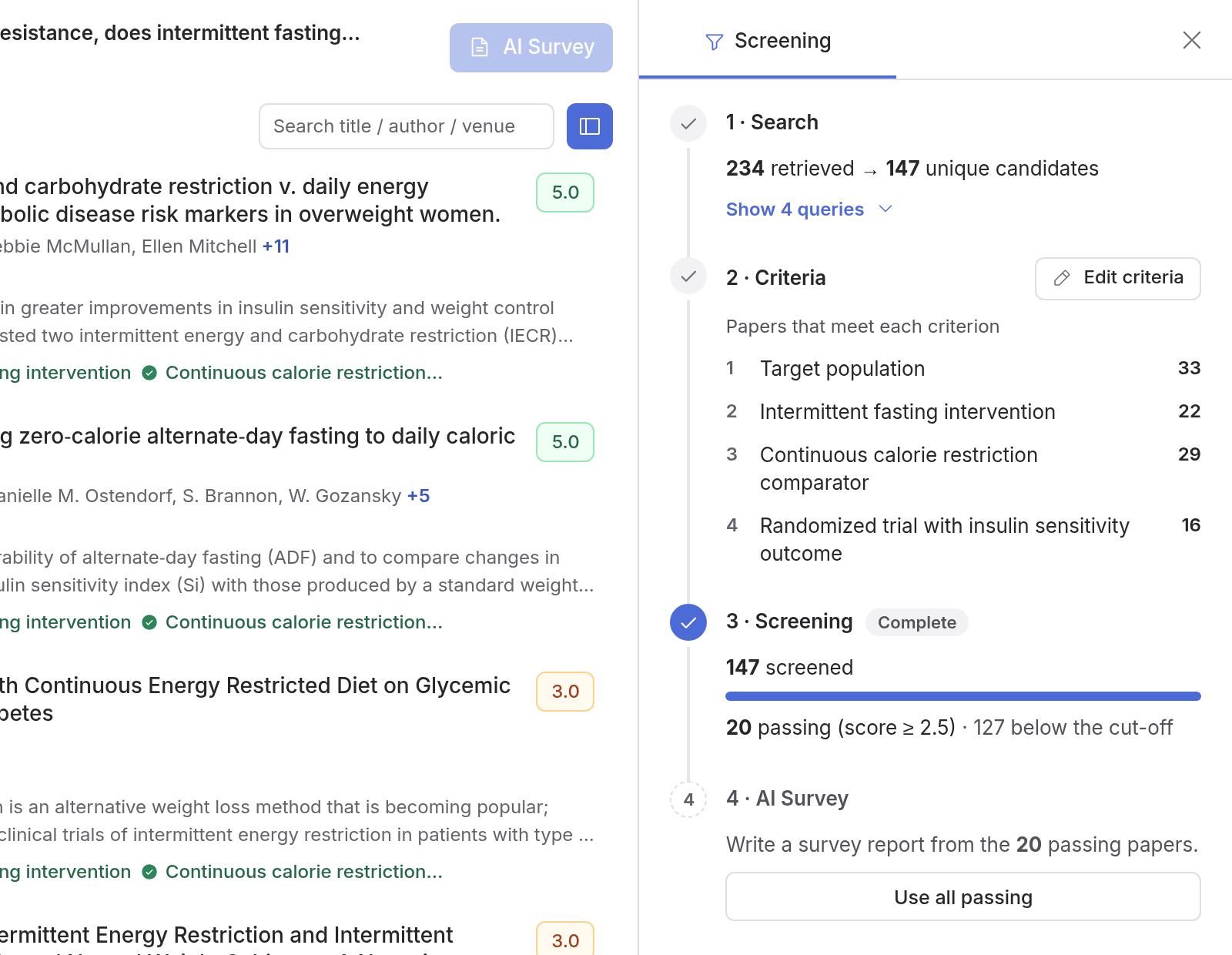
One phrasing finds one slice of the literature. AI Search expands your question into several complementary searches — synonyms, methods, domain terms, exact phrases, recent work, and highly cited work — and lists them next to the results, so you know exactly what was searched. For the first proposal, four searches found 234 records; with one more batch, AI Search screened 147 unique candidates. The searches included:
(“intermittent fasting” OR “intermittent energy restriction” OR “5:2 diet”) AND (“insulin resistance” OR “HOMA-IR” OR HbA1c) AND (randomized OR randomised OR “randomized controlled trial”)
(“intermittent fasting” OR “alternate-day fasting” OR “intermittent energy restriction” OR “5:2”) AND (“euglycemic clamp” OR “hyperinsulinemic clamp” OR “insulin sensitivity index” OR “oral glucose tolerance test”) AND (obesity OR overweight OR “insulin resistance” OR prediabetes)
03
Screen every paper against explicit criteria
AI Search turns your question into screening criteria — here, target population, intermittent fasting intervention, continuous calorie restriction comparator, and randomized trial with insulin sensitivity outcome.
It then reads each candidate's title and abstract, checks it against every criterion, and gives the paper a 0–5 score. Each result shows the criteria it meets, and the panel beside the list counts how many papers meet each one.
20 of 147 screened papers passed the 2.5 cut-off.
04
Stay in control of relevance
Add your own criterion — a name and a screening question — and rerun the screening against it.
Set a score threshold, or show everything, and sort by relevance, citation count, or year.
Screen more when the first batch of papers is not enough.
05
Keep the best papers, or go on to a review
Add papers to your library, or copy them as APA, BibTeX, or plain text. Every run is saved to your history. When you need a written synthesis, turn the passing papers into an AI Survey (Plus and Pro plans), or describe a custom analysis to the Researchzy Agent.
Why you can trust the ranking
Relevance you can inspect, not a black box.
The reasons are visible
Every score comes with the criteria the paper meets, so you can see why it ranked high or low.
The papers are real
AI judges relevance; it does not write citations. Every result is a record from the scholarly index, with its abstract and source links.
You set the rules
Edit the criteria, adjust the threshold, and open any paper. AI Search narrows the reading; the judgment stays yours.
Good to know
AI Search screens papers from their titles and abstracts. Open the full text of the papers you rely on.
AI Search uses AI credits; the free Basic plan includes AI credits every month. See pricing.